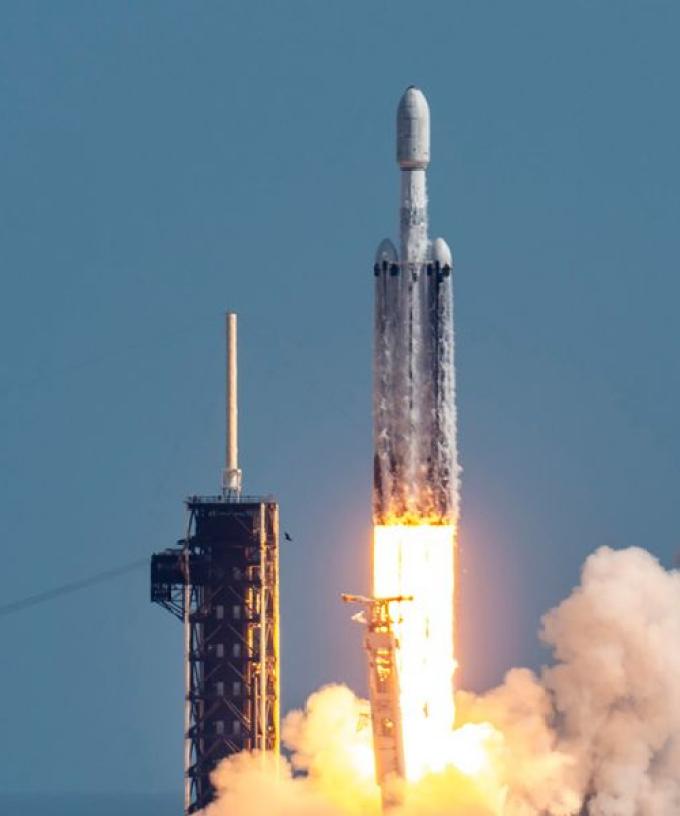
Australia’s sky just gained a powerful new resident. ViaSat-3 F3, a six-tonne communications satellite purpose-built for the Asia-Pacific region, has successfully reached orbit after launching aboard a SpaceX Falcon Heavy rocket from Kennedy Space Center. With Qantas, Jetstar, NBN Co’s Sky Muster service and the Australian Defence Force all part of Viasat’s existing footprint here, the spacecraft now climbing toward its final orbital slot has been engineered with Australian users squarely in mind.

ViaSat-3 F3 is engineered to deliver more than one terabit per second of throughput across its coverage footprint, a figure that would have read as science fiction only a generation ago. The spacecraft relies on an advanced beam-forming payload, which allows operators to steer capacity dynamically across the region in response to real-time demand. Rather than serving fixed beams that cannot be redirected once a satellite is in service, ViaSat-3 F3 can concentrate bandwidth wherever it is needed most, whether that is over a packed flight corridor, a maritime shipping lane or a remote inland community. According to Viasat chairman and chief executive Mark Dankberg, the satellite is designed to provide greater resilience for government and commercial mobility users, supporting both civilian and defence operations.

For Australia, the launch represents the culmination of more than a decade of cooperation with Viasat. The company has worked with NBN Co since 2012 on the ground systems that power the Sky Muster service used by regional and remote households, and it counts Qantas among its long-standing in-flight connectivity partners. Earlier this month, Jetstar joined the fold, selecting the new multi-orbit Amara platform to equip 11 refurbished Boeing 787 Dreamliners on its long-haul international routes. The Australian Defence Force, which currently relies heavily on the United States Wideband Global Satcom system, is also expected to benefit from additional sovereign-friendly capacity once F3 enters service.

Service entry is not immediate. The satellite will spend the coming weeks travelling from its handover orbit out to its final geostationary slot near 155 degrees East, using onboard electric propulsion to climb the roughly 36,000 kilometres to operational altitude. From there, the spacecraft will deploy its large reflector antennas, complete an extensive in-orbit testing campaign and integrate with Viasat’s ground network. Service is currently scheduled to begin around August or September, completing a constellation that already includes ViaSat-3 F1 over the Americas-facing flight corridors and ViaSat-3 F2, which is progressing through its own in-orbit testing.
To put one terabit per second into perspective, that single number represents roughly the same throughput as tens of thousands of typical Australian fibre-to-the-node connections running at full tilt simultaneously. Each of those bits is transmitted from a ground gateway up to a spacecraft sitting roughly 36,000 kilometres above the equator, then routed back down to a user terminal somewhere across the Asia-Pacific, all within a fraction of a second. The beam-forming payload onboard can reshape and redirect that capacity across the region in milliseconds, faster than a passenger could finish a sentence, allowing the network to follow demand as it shifts between cities, oceans and flight paths in real time.
Most of that bandwidth will be consumed quietly, in the background of ordinary life. Cloud backups, streaming caches, smart meters, vehicle software updates, GPS corrections, agricultural imagery, maritime tracking, weather modelling and emergency communications all draw on the same expanding pool of orbital and terrestrial capacity. From a few dots of Morse code in the 1800s to a trillion bits per second over the Asia-Pacific in 2026, every leap in bandwidth has redrawn the map of what is possible. So the question worth asking is a simple one: what will Australia choose to do with all of it?